
'The Chinese staying put in Pangong Tso, and creating a buffer zone on Indian territory in other areas,' a senior serving general tells Ajai Shukla.

The best, wisest, and fairest next step in strengthening our own cause is to restore statehood to Jammu & Kashmir and allow the resumption of robust political activity. That's a box that remains unchecked on the Modi government's report card as we approach the fourth anniversary of Kashmir's Constitutional shift, notes Shekhar Gupta.
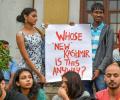
The Supreme Court said on Thursday the surrender of Jammu and Kashmir's sovereignty to India was "absolutely complete" with the accession of the former princely state in October 1947, and it was "really difficult" to say that Article 370 of the Constitution, which accorded special status to the erstwhile state, was permanent in nature.

'It is a pattern of behaviour of the Chinese that whenever a Chinese leader visits India or an Indian leader visits China, some incidents take place.' 'When Modi visits China, we should look out for some similar demonstration by the Chinese.'

Rulers in New Delhi and their political aides in sensitive states like Tamil Nadu have to be doubly careful not to provoke a situation whose consequences may be much more than visible now to the naked eye, notes N Sathiya Moorthy.
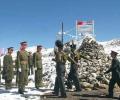
People familiar with the situation in the region said the two sides were engaged in trying to resolve the dispute, but there was no indication of a positive outcome yet as both the armies continued to bolster their positions in disputed areas of Pangong Tso and Galwan Valley and Demchok.
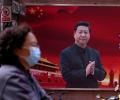
China has not limited the 'battle' to the diplomatic field alone; the People's Liberation Army has become aggressive on the ground too. The recent 'fights' in Northern Sikkim and Ladakh are part of the pattern, asserts Claude Arpi.

India must break out of this strategic triangulation between China and Pakistan. We need to settle our issues with one of the two, notes Shekhar Gupta.
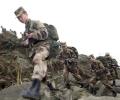
Hours after withdrawing from the Chumar region in Ladakh, Chinese People's Liberation Army soldiers were on Friday reported to have crossed into Indian territory again and stationed themselves on a hillock.

Dispelling the notion that India-China are rivals, Bambawale also said there is no "anti-China mentality" in India.

'The numbers of troops on both sides are enormous.' 'They are about 50,000-60,000 soldiers facing each other in that sector -- that's about the total number of troops that both sides had in the 1962 War in all sectors.'

'The Chinese forces in the narrow Chumbi Valley are currently in the line of sight and fire of Indian forces poised on the ridges along the Sikkim-Tibet border.' 'Aware of this vulnerability, the Chinese have been eyeing the Doklam plateau,' explains national security expert Nitin A Gokhale.
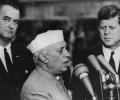
On Jawaharlal Nehru's 134th birth anniversary, Utkarsh Mishra recounts incidents where the first prime minister showed exemplary courage, bravery and integrity.
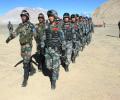
Indian and Chinese troops remained engaged in an eyeball-to-eyeball situation in several disputed areas.

China said on Monday it regretted that two Indian athletes were blocked last week from going to China but defended measures it has put in place in response to a border dispute which led to the ban on the pair travelling.

Singh also said that Indian security forces were capable of defending the country's territories.

His attack on the government came days after Indian Army personnel clashed with Chinese soldiers in the Tawang sector in Arunachal Pradesh.

New Delhi can strengthen its leverage by having better relations with the two than they have with each other.

Iran's decision to keep India out and welcome China to the scene is a huge strategic setback for India, observes Dr Rajaram Panda.
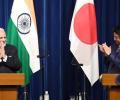
'Relations between India and Japan are robust and devoid of either shadow of history or any irritant.' 'In fact, there is plenty of warmth and goodwill earned over history. There are no negatives but only opportunities,' notes Dr Rajaram Panda.
In the 15-year dataset, the researchers noted an average of 7.8 incursions per year even though the Indian government's estimates are much higher.

The US actions can be seen as a riposte to India's neutral position on the Ukraine crisis, its continuing import of Russian arms and oil thus undermining Western sanctions, argues Colonel Anil A Athale (retd).
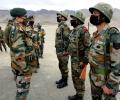
The seventh round of military talks between India and China held on Monday was "positive and constructive", and both sides agreed to earnestly implement the understanding reached by their leaders to not turn differences into disputes, a joint statement by the two armies said on Tuesday.

In an angry reaction to US Defence Secretary Ashton Carter's remarks that "China's actions could erect a Great Wall of self-isolation" in the South China Sea, Chinese foreign ministry spokesperson Hua Chunying told media that "Carter's remarks reflected typical American style thinking and hegemony".

Arpi deserves to be complimented for the commitment and hard work that have gone into this production. The frustrations of seeking reliable documentation from the catacombs of the Indian bureaucracy did not deter him from going after the best information available, and the result is one that he can take much satisfaction in. Ambassador Prabhat P Shukla, Member Advisory Council, Vivekananda International Foundation, reviews Claude Arpi's The End of an Era: India Exits Tibet.
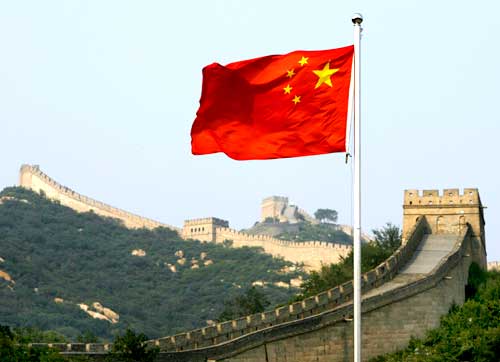
Asking the US to respect the efforts by China and India to resolve their boundary dispute peacefully, a top Chinese official on Monday said the two nations are wise enough to deal with it after the Pentagon accused Beijing of deploying more troops along the Sino-India borders.

Refusing to share in the euphoria of ally Bharatiya Janata Party over Prime Minister Narendra Modi's China visit, Shiv Sena on Monday accused the neighbouring country of pursuing a policy of "hugging from the front and stabbing from behind".
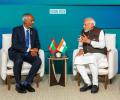
The row erupted on a day President Dr Mohamed Muizzu embarked on a week-long visit to China.

'A participant in many rounds of the border talks with China once told me that China seemed not interested in resolving the border issue as it wanted to keep it as a ready excuse to intervene in the sub-continent,' says Colonel (retd) Anil A Athale.
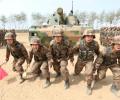
Last year, the country's defence budget was $175 billion.
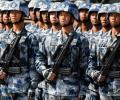
'The possibility of another incursion, a probing manoeuvre in areas where Indian defences are vulnerable cannot be ruled out.'

The government has adopted a multi-pronged approach involving the Army, the Indian Air Force and the Navy as well as diplomacy and economic measures to send out a firm and clear message to China that its misadventure in eastern Ladakh was not acceptable at all.

The responsibility for peace in Ukraine now rests in the hands of the two principal belligerents, Russia and the US, and the prime victim of this great power rivalry, Ukraine, points out Nitin Desai.
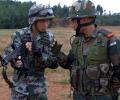
Hua also said China is ready to hold talks with India to resolve differences on CPEC.
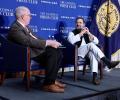
Asserting that Indian democracy is a "global public good", Congress leader Rahul Gandhi has said that its "collapse" will have an impact on the world and is not in America's national interest.
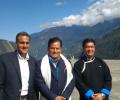
China claims Arunachal Pradesh as part of southern Tibet and routinely protests visits by Indian leaders, foreign officials as well as the Dalai Lama to the area.
'Modi ji, now why are you hesitating to show red-eye to China in Ladakh?'
'Given the present force levels, India cannot fight and win.' 'India can't hope to terminate the conflict on India's terms and impose the nation's will upon the adversaries,' says Brigadier Gurmeet Kanwal (retd).

China will increase its defence spending by "around seven per cent" this year, as it vowed to guard against "outside meddling" in its territorial disputes.
Addressing a meeting of the Congress Working Committee, he said there has been a 'complete and total failure' of foreign policy under the Modi government.
